



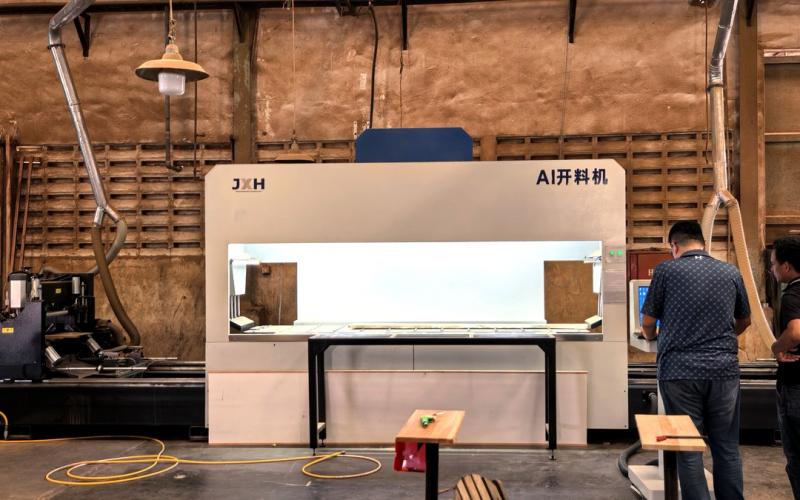
Manual marking is one of the most time-consuming steps in many solid wood factories. Workers need to check each board, avoid defects, decide where parts should go, and prepare the cutting plan. AI cutting machines help turn this process into a more repeatable production workflow.
What manual marking usually includes
- Checking knots, cracks, and unusable areas
- Drawing part positions by hand
- Deciding how to use irregular board areas
- Communicating the layout to the cutting operator
How AI changes the workflow
Instead of relying only on manual judgement, the board is scanned and analyzed. The system can generate a nesting layout and send it to the cutting or marking process. This reduces repetitive decisions and helps operators focus on production control.
When dual-station cutting helps
For higher output, a One-Dual-Two AI Cutting Machine can use one AI scanning workflow with two cutting stations. This allows factories to improve throughput while handling different boards and cutting tasks in parallel.
Recommended JXH products
Factories that want to reduce manual marking can start with the JXH AI Cutting Machine. For higher capacity, the JXH One-Dual-Two AI Cutting Machine is suitable for production lines that need stronger output.
FAQ
Can operators still adjust the result?
Factory workflow requirements vary. In many practical systems, operators can review production requirements and adjust settings before cutting.
Which factories benefit most?
Furniture, wooden kitchenware, and solid wood component factories with irregular boards and repeated marking work usually benefit the most.